Did an AI Image Edit Preserve the Product? Inspect a Background Swap
Inspect an original teal-mug background edit, compare its visible geometry and materials, and build an acceptance checklist without claiming pixel-perfect preservation.
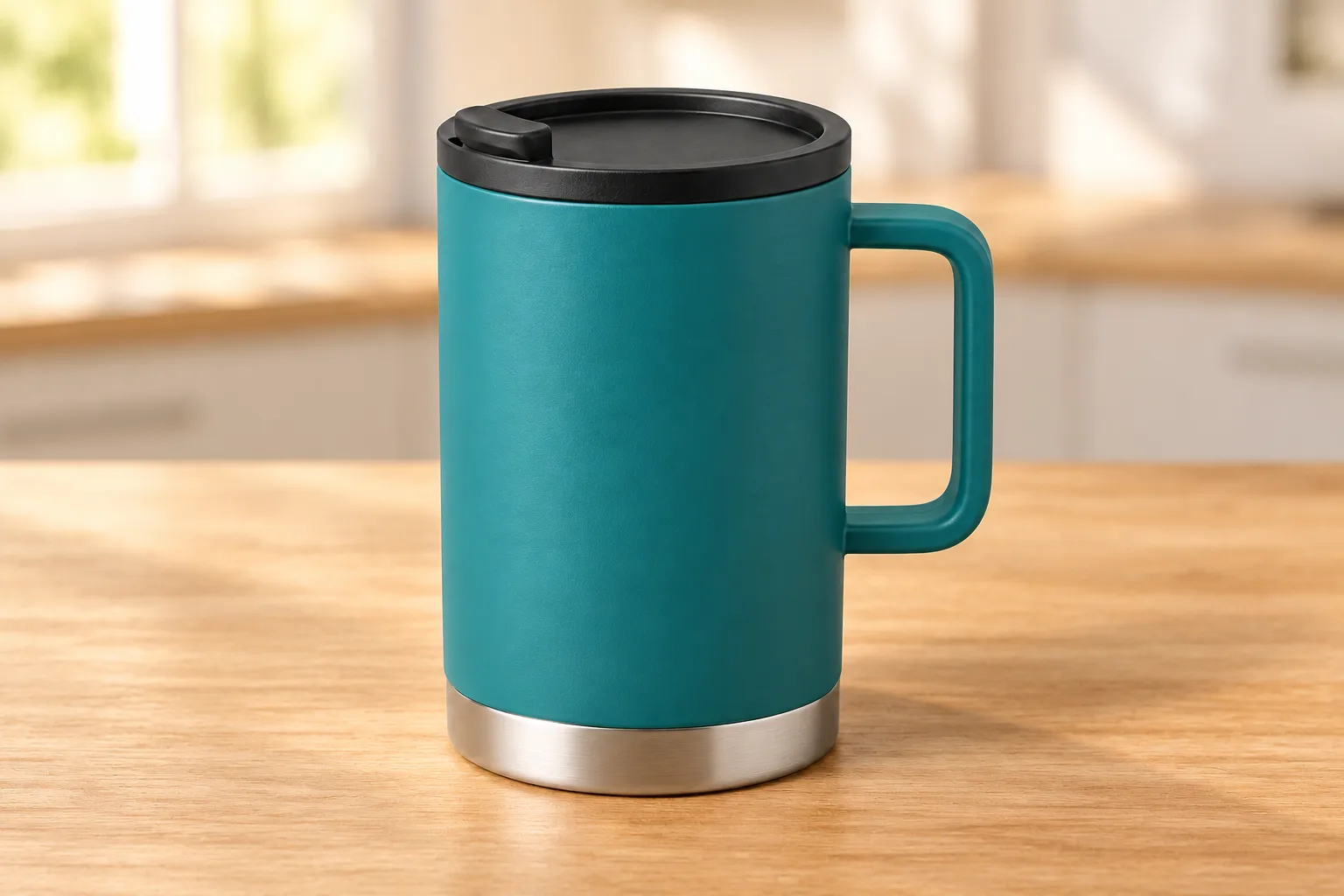
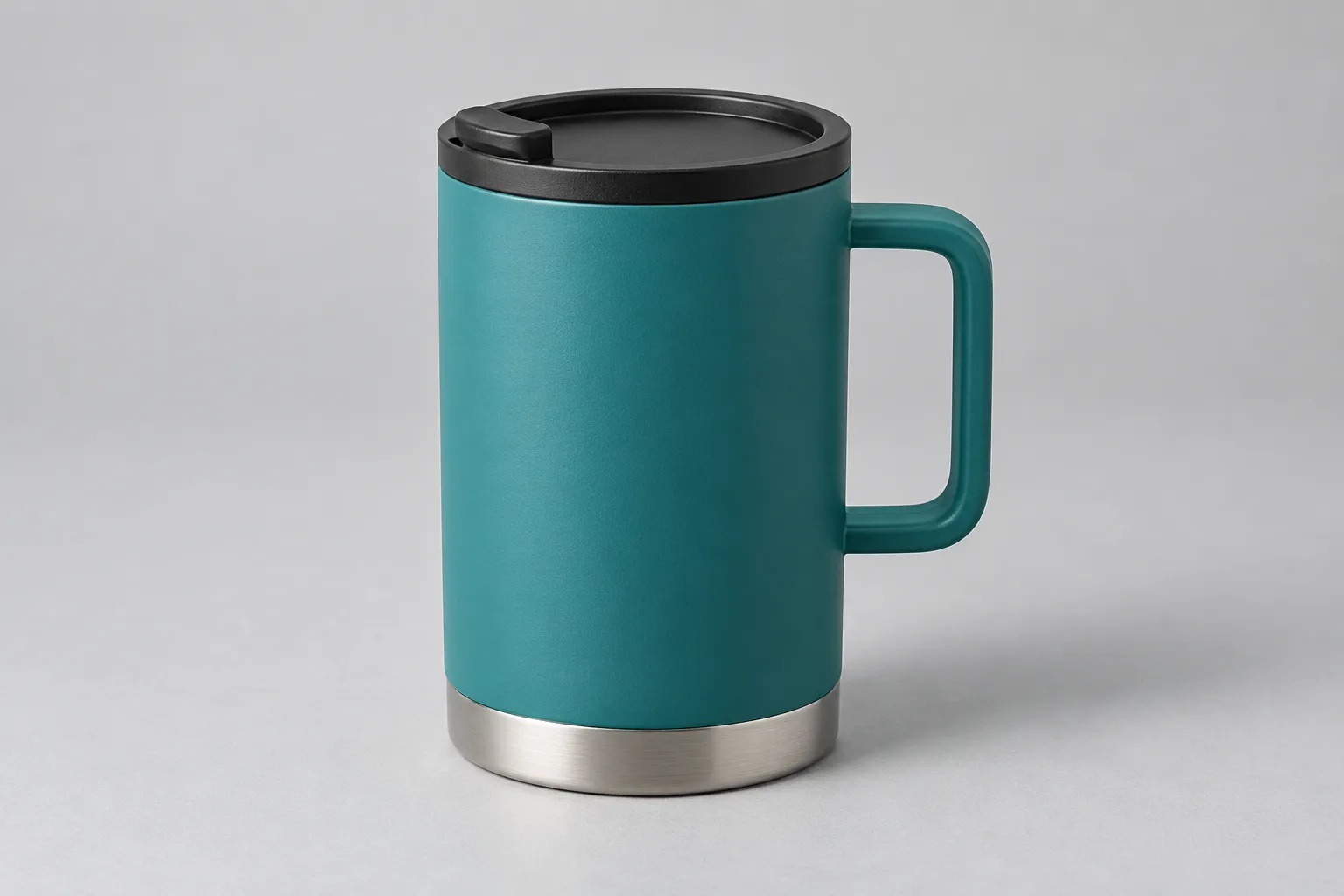
Start with the teal mug’s right handle. A more attractive kitchen background does not rescue an edit that changes the object you meant to keep. For this exercise, the Codex built-in image tool produced an original fictional mug on a gray surface, then edited that reference into an oak-tabletop scene. Both outputs are 1536 by 1024 pixels. The inspection described here concerns those two files, not a physical mug, a commercial product or a comparison between image models.
Start with the handle, not the prettier room
In the reference image, the handle forms a distinct rounded rectangular loop anchored to the right side of the straight cylindrical body. Its interior opening forms a clean window of background space between the mug wall and the inner grip surface. When examining the edited kitchen output side by side at identical scale, the initial inspection decision centers on that aperture. If the edit fills that negative space with solid color, pinches the inner opening, or alters the thickness of the outer grip, the mug ceases to represent the original fictional article. In our actual visual observation of the two output files, the right rounded rectangular handle remains present, centered, and structurally recognisable, retaining its open interior and clearance from the teal mug wall without obvious collapse or warping.
Recognisability and geometric equivalence are different decisions. No coordinate mask or pixel lock was supplied in this exercise, and no numerical contour comparison was run. The visual inspection therefore supports a provisional observation: the handle still looks recognisable at the displayed scale. It does not establish that the dimensions are identical. In a hypothetical asset review, a changed upper joint might be easy to overlook when the new room looks convincing. If the joint matters to the brief, mark that uncertainty and inspect it more closely before accepting the asset. Do not turn a visual impression into a measured tolerance.
Write down what the edit is allowed to change
Write an allowed-change list before asking for a background swap. Name the parts that should remain: body, handle, lid, drinking tab and metal band. Separately describe the new setting and any permitted adjustment to its contact shadow. This makes acceptance less dependent on whether the result looks attractive. The actual edit request for this exercise specified oak and a sunlit kitchen while asking to keep mug geometry and lighting close to the reference. The resulting file must be judged against that request; a prompt does not enforce a protected region by itself.
OpenAI’s image-generation guide identifies visual consistency and precise composition as limitations that still require attention. A successful generation call is not, by itself, evidence of exact preservation. OpenAI image generation guide: limitations
The non-negotiable category contains the complete geometric and material signature of the fictional reference object. For the teal mug, the outer silhouette must remain static: the vertical edges of the main cylinder cannot taper, bulge, or tilt. The right-hand rounded rectangular handle must retain its exact perimeter, wall thickness, and negative interior opening. The top closure, consisting of a black circular lid with a raised drinking tab situated at the front left, cannot shift perspective, rotate, or alter its relief height. At the bottom, the narrow brushed steel band must maintain consistent vertical height and straight horizontal alignment. Any dimensional distortion or structural morphing in these designated regions constitutes an immediate rejection of the generated output.
Open the original gray-background reference alongside the edited image at the top of this article. Compare the right handle, the front-left drinking tab, the upper rim and the steel band before deciding whether the background change is usable.
Lighting needs its own boundary. The request used here asked to keep the lighting on the mug close to the source and allowed the contact shadow to adapt if needed. It did not authorize a wholesale change to the mug’s material or color. The edited file has a different surrounding palette, and some highlights and reflections look different. That may be acceptable for a conceptual illustration, but it is still a change to record. If the task instead requires an unchanged product cutout, preserving the original object on a separate layer may be a more appropriate method to investigate. That compositing method was not run in this exercise.
A concrete failure case demonstrates how this boundary list governs operational decisions. Consider a fictional review scenario where an operator inspects a background swap and observes that the warm illumination from the oak tabletop washes over the lower third of the mug, shifting the perceived paint finish from clean matte teal to an uneven olive green. While ambient bounce was permitted on paper, this result crosses the boundary into altering the core product material. The recovery procedure requires an immediate rejection. Rather than issuing vague subjective prompts asking for more clarity, the operator references the allowed-change criteria and introduces targeted negative constraints to restrict color shifts on the cylinder, or isolates the object using a preserved layer boundary.
Establishing these rules upfront also exposes procedural alternatives. The test case evaluated a single direct image-to-image replacement without a numeric mask or pixel lock. This approach relies entirely on prompt comprehension and the tool following the request; the OpenAI guide separately identifies consistency and composition as limitations. If an operator requires zero tolerance for geometric variance, the alternative is a multi-step compositing workflow: masking the mug, generating the background independently, and manually managing edge blend and shadows. Deciding whether to accept direct prompt-based editing depends entirely on whether the observed outputs satisfy the documented boundary criteria without requiring pixel-level reconstruction.
Original scene request
Use case: product-mockup. Original controlled product scene for an editorial experiment inspecting whether an image edit preserves a product's shape. A single unbranded matte teal insulated travel mug, straight cylindrical body, one rectangular rounded handle on its RIGHT, circular black lid with one small raised drinking tab at FRONT LEFT, narrow brushed steel band around the base. On an empty neutral pale gray studio tabletop, uniform pale gray backdrop. Camera at mug mid-height, slight view down onto lid, exactly one mug centered, whole object visible, soft shadow to right, 3:2 landscape. Realistic product photography with precise hard edges and material texture. No lettering, logos, decorative grooves, other objects or watermarks. This is a fictional test object and not a commercial product.
Background edit request
Use case: precise-object-edit. EDIT TARGET: the provided image of one fictional teal travel mug. Change ONLY the tabletop and background from neutral gray studio to a warm light oak tabletop and softly blurred sunlit kitchen, with no additional objects. Preserve the mug pixel geometry as closely as possible: same teal cylindrical body, same exact height and width, same RIGHT rounded rectangular handle with same inner opening, same black circular lid and FRONT LEFT raised tab, same narrow brushed steel base band, same camera viewpoint, placement and overall image dimensions. Preserve texture and edge contours. Keep lighting on mug close to source; adapt only contact shadow if necessary. No added text logos or watermarks. A controlled background-only edit for visual inspection, not evidence of a real product photoshoot.
What the two actual outputs show
Placing the two 1536×1024 rendered frames side by side establishes the baseline for qualitative visual evaluation. The original reference asset displays a single, unbranded matte teal cylindrical travel mug centered against a flat, neutral pale gray studio tabletop and background. To its right extends a distinct rounded rectangular handle with a clean negative-space cutout, while the top is sealed by a circular black lid featuring a small raised drinking tab positioned at the front-left quadrant. A narrow, brushed steel ring forms the base, grounding the vessel on the gray surface with a soft, uniform shadow cast toward the right. In the edited output, the primary change requested in the prompt is immediately visible: the sterile gray environment has been replaced by a warm light oak tabletop set before a softly blurred, sunlit domestic interior. At first inspection at standard display scale, the core object remains unmistakably the same fictional vessel, retaining its primary cylindrical proportions, upright orientation, and structural parts.
At the displayed scale, the outer cylinder, handle opening, black lid and steel base look closely aligned between these two files. The new oak surface and bright background also change the visual context. Reflections, tonal appearance and the contact shadow differ. These are qualitative observations from Codex visual inspection, without a calibrated display, numerical overlay or physical reference. They cannot establish exact color, material response or geometric tolerance. The useful result is narrower: the main visible features remained recognisable in this one background edit, while some appearance details changed. A future job with smaller features or a different view would need its own inspection.
Consider a hypothetical design review using those observations. The reviewer opens the gray-background reference and the edited image, matches their displayed size and checks each named feature. Is the drinking tab still at the front left? Is the handle opening still clear? Does the steel band remain visible? For a conceptual editorial image, a team might accept the result after those checks. For a product-accuracy task, the same observation is insufficient: the starting mug itself is fictional, and no real product measurements were supplied. There is no legal or technical certification implied by the visual inspection.
A concrete failure case within this stage occurs when the generative model attempts to blend the base of the mug into the new surface. In a hypothetical alternative pass, not performed here, the brushed steel rim might pick up excessive specular scatter from the oak grain, softening the crisp baseline into a fuzzy edge that appears wider than the source geometry. The recovery procedure for this failure requires rejecting the output rather than guessing with conversational prompt adjustments. The operator documents the boundary bleed, switches to a workflow alternative that incorporates a hard alpha mask over the product silhouette, and restricts generative synthesis entirely to the background pixels outside the object's verified boundary.
Inspect the silhouette before judging the finish
When evaluating an image after an automated background modification, the visual finish can easily deceive human reviewers. Rich tabletop warmth, realistic specular highlights, and natural-looking depth blur create an immediate impression of photorealism that distracts from structural alterations. For this reason, an inspection workflow must isolate the object's outer silhouette before assessing color, gloss, or texture. If the outer perimeter, the drinking tab contour, or the interior void of the handle has altered in shape, the material properties of the mug no longer matter. Evaluating surface realism on a compromised profile wastes review time because no refinement of shadow or tone can correct an underlying distortion of the product geometry. A disciplined inspection checks boundary stability first, treating the outer contour as an independent pass.
A reader could go beyond the inspection performed here by aligning two images in an editor and toggling their visibility or placing an edge overlay above them. No such overlay was run for this article. Start by checking that dimensions, cropping and viewpoint match; an apparent contour shift can otherwise come from alignment rather than editing. Compare the cylinder sides, handle attachment points, lid rim and drinking tab separately. If alignment is uncertain, record it rather than adjusting the files until the shapes appear to agree. The purpose of the proposed procedure is to expose a disagreement, not hide one.
Define the response to a possible contour change before looking at the finish. A thickened handle might require a rejection, another focused attempt or an explicit limitation on use. An edge-detection or silhouette view can help investigate an ambiguous boundary, but it is a heuristic. Shadows, translucency, contrast and threshold settings can all affect an extracted outline. Such an outline is not a physical measurement or automatic ground truth. Keep the original color image available and review the edge result against it. Choose a numerical method only when its inputs, alignment assumptions and acceptance threshold are specified.
A possible failure case during background replacements occurs along high-contrast interior boundaries, particularly the inner loop of the mug handle. Because the generative process must synthesize oak cabinetry and sunlight through this small opening, it might alter the interior edge of the plastic, thinning the handle grip into an unnatural taper or leaving jagged digital residue where the negative space meets the teal finish. When this defect appears, the recovery procedure does not involve tweaking the edit prompt with descriptive adjectives like sharp edges or precise handle. Instead, the operator logs the failure as a boundary hallucination, discards the frame, and implements an alternative compositing workflow. In this corrective path, the operator extracts a hard boundary matte from the original studio mug, locks the silhouette against generative rewriting, and runs the background generation exclusively on the exterior coordinate space.
Treat light, texture and contact shadows separately
After the outline, inspect surface appearance in separate passes. Look at the teal body, the black lid and the steel band, then at how the base meets the table. The edited surroundings can change perceived color even when a region looks broadly similar. Conversely, an attractive highlight can hide an unwanted material change. This exercise did not measure lighting, reflectance or color difference. The inspection therefore describes visible appearance rather than explaining the rendering process or establishing the mug’s physical coating. Keep those distinctions in the notes so later readers know what the image can demonstrate.
For the body, ask whether the reference’s matte appearance remains plausible or whether a new glossy patch distracts from it. For the lid, check the raised tab and the separation between lid and cylinder. For the steel band, look for a retained band rather than a newly painted shadow that resembles one. A highlight alone cannot identify a material: its appearance also depends on lighting and viewpoint. If the finish matters to the task and the images leave it ambiguous, mark that ambiguity for further work. The brief should determine the decision, rather than an unsupported claim that a visual cue proves a particular physical surface.
Check the contact region at the base on its own. Does the mug appear to sit on the oak, or is there a visible gap, dark halo or blurred edge that makes placement unclear? Compare that region with the original gray-surface file without assuming that one shadow shape is mandatory for every lighting setup. This is an appearance check, not a reconstruction of the scene’s lights. In these outputs the tabletop and contact shadow changed; no numerical shadow analysis was performed. If a defect is suspected, keep a close crop as a review aid and identify the uncertain region in the next request.
The English workflow library approaches tool output as something to inspect against a task. For an image edit, a convincing room is secondary to the object properties the request promised to preserve.
When color temperature makes it difficult to separate true texture loss from lighting tint, an effective alternative is luminance inspection. By stripping saturation and viewing both images in grayscale, the reviewer can evaluate surface roughness and shadow density without being misled by oak reflections or teal saturation. A hypothetical failure case occurs when strong directional sunlight in the background causes the model to obliterate contact shadows entirely while painting heavy specular highlights across the matte body. The recovery procedure requires rejecting the overall lighting composite rather than attempting multiple vague prompt retries. The operator retains the successful background environment plate, extracts the original uncorrupted studio mug with its true matte texture, and composites it manually, applying a controlled ambient occlusion shadow and a subtle warm color overlay to achieve realistic environmental integration without altering the mug's physical finish.
Choose acceptance rules for the intended use
Acceptance criteria cannot be absolute because no single standard fits every commercial application. A background edit acceptable for a casual marketing placement may fail completely on a technical product listing. Determining whether an image edit preserves product shape depends entirely on the tolerances defined by the downstream channel. Consider a fictional scenario where the teal travel mug is prepared for two different channels across United States and Canadian online storefronts: a primary e-commerce product detail page and an ambient lifestyle hero banner. These two contexts demand fundamentally different thresholds for contour stability, color cast, and feature clarity.
For an accuracy-sensitive product listing, a fictional generated reference cannot establish real product dimensions, coating or construction. A real listing would need an appropriate verified source and its own acceptance criteria. Even with such a source, a background edit should be checked for visible changes in body width, handle opening, lid detail and base height. The acceptable color range and review method should come from that task’s requirements. The example here supplies a way to organize those questions; it does not certify the edited mug as accurate for sale or establish a universal catalog standard.
In contrast, an editorial or lifestyle application operates under an ambient acceptance rule where contextual plausibility is prioritized over strict boundary preservation. For a seasonal lifestyle graphic or email header, the viewer evaluates the overall scene rather than microscopic product dimensions. Under this rule, warm sunlight filtering across the lid and subtle oak-tinted highlights along the cylindrical body are acceptable compromises that embed the mug into the room. However, this flexibility still has non-negotiable boundaries. The mug must remain instantly recognizable: the handle must retain its distinct rectangular profile with an open interior void, the drinking tab must remain visible at the front left, and the base must sit level without warping or floating.
A hypothetical operational failure occurs when production teams apply a single, vague approval standard and allow assets to drift between tiers without clear governance. In this fictional scenario, an inspection operator accepts an edited kitchen image because the oak surface looks rich and realistic, overlooking that the front-left drinking tab has softened into an indistinct bump and the brushed base band has narrowed. Weeks later, that image is mistakenly pulled from the shared asset library and placed on a retail card beside published physical dimensions. Customers noticing the altered lid profile question whether the product was redesigned or if the shipment will match the photography.
Separate uses in the asset record. A conceptual image accepted for an editorial layout should not silently become a verified catalog reference. If a later task needs closer preservation, return to the original source and assess a different editing method. A layered composite that keeps the source product separate from a generated background is one possible next experiment. It was not performed here, and it would still need checks for alignment, edge blending and export changes. Neither compositing nor a more detailed prompt can prove physical accuracy when the source object itself was never verified against a real product.
Keep the files and repeat only a focused change
Keep the exact input and output files beside their requests. In this exercise the gray reference and oak-tabletop edit were saved as 1536 by 1024 PNG files, with separate SHA-256 hashes and tool provenance in the project record. PNG is a compressed lossless format; retaining the returned files avoids confusing later re-exports with the original outputs. The tool result did not disclose an exact underlying model version, so the record names the built-in image tool rather than guessing one. An archive supports comparison, but two saved files alone cannot establish whether a difference came from a particular internal model process.
Consider a concrete fictional scenario involving a product catalog manager named Marcus who is preparing lifestyle imagery for a line of insulated drinkware. Marcus notices that after an edit intended to warm the background lighting, the narrow brushed steel band at the mug base has gained an uneven wavy contour, while the cylindrical body and right handle remain well proportioned. Instead of issuing a new prompt that describes the entire room, table, lighting, and tumbler from scratch, Marcus restricts his intervention. He preserves the initial source image and the revised kitchen plate, isolating the single defective region. In his next request, he holds the environmental description constant and supplies a tightly focused correction instruction directed solely at the bottom edge and metal band, asking the tool to reduce changes to the handle or lid that had already passed visual inspection.
A possible operational failure occurs when operators compound errors through layered conversational adjustments. In this failure case, an operator sees a slight distortion in the mug base and submits a general request to sharpen the entire object and brighten the scene. The underlying model attempts to fulfill both requests at once, overcompensating by sharpening the previously acceptable front-left drinking tab until it resembles an exaggerated spike, while altering the oak table grain into high-contrast streaks. The asset drifts further from the source master with each successive prompt cycle. When the team eventually realizes the product geometry has warped, they have no record of which intermediate step introduced the distortion, forcing them to abandon the entire sequence.
Recovery from compounded drift requires reverting to the original baseline file rather than attempting to fix an already degraded edit. The operator must re-anchor the workflow to the pristine source master, establishing a branched revision structure where each focused change is evaluated independently. If a background swap succeeds across the general scene but consistently softens a fine feature like a raised drinking tab, the operator should consider alternative correction workflows. Rather than continuing with background-only generative prompts, the team can apply a local masking approach or composite the unchanged pixel region of the original tab over the edited background plate. Archiving every intermediate file helps ensure that if a focused generative correction introduces new artifacts, the operator can immediately step back to the last acceptable state without starting over.
Prepared with AI assistance and automated editorial and meaning reviews. The source and edited images were produced and visually inspected for this article. The mug is fictional; no physical product was photographed or measured.